
Planning new floors? The first question most people ask is about cost. For 1,000 sq ft fully installed in Singapore, the answer depends on your chosen material, your existing floor condition, and the prep work required before anything goes down.
This article breaks down total costs by material. It explains what drives the final number and helps you compare quotes more accurately before committing to any contractor.
GET IN TOUCH
Schedule a Visit
Estimated Total Cost to Floor 1,000 Sq Ft
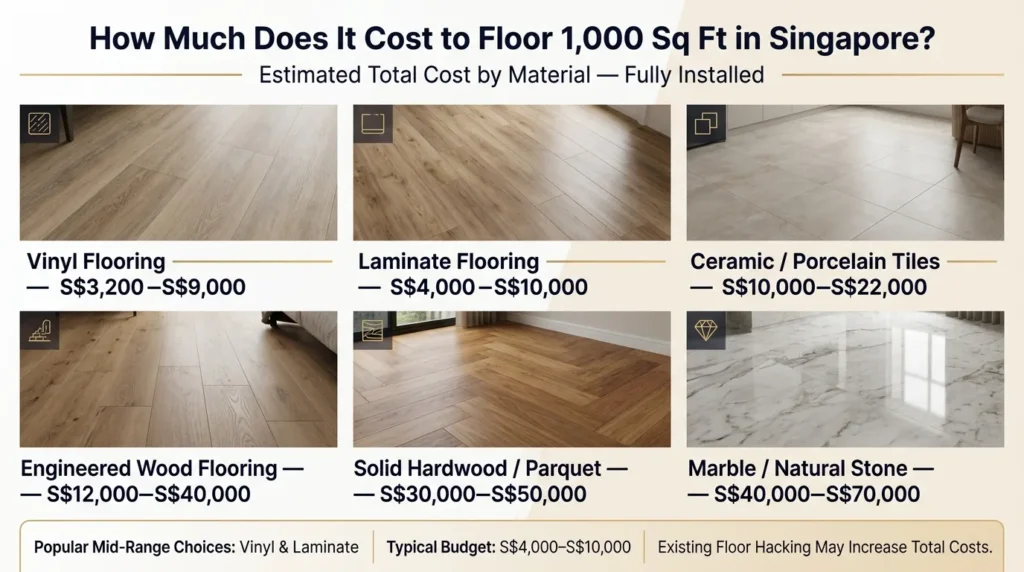
The total cost to floor 1,000 sq ft fully installed in Singapore ranges from S3,200toS50,000+, depending on the material and scope of work.
Vinyl flooring sits at the lower end of the range. Marble and solid hardwood sit at the top. Most mid-range residential projects using laminate or vinyl fall between S4,000andS10,000. That estimate is for 1,000 sq ft including labour.
The wide range exists because “flooring” covers materials with very different prices and installation requirements. A vinyl plank job and an engineered hardwood job involve entirely different labour, tools, and preparation.
Cost Breakdown by Material
| Flooring Type | Estimated Cost for 1,000 Sq Ft (Fully Installed) |
| Vinyl flooring | S3,200–S9,000 |
| Laminate flooring | S4,000–S10,000 |
| Ceramic / Porcelain tiles | S10,000–S22,000 |
| Engineered wood flooring | S12,000–S40,000 |
| Solid hardwood / Parquet | S30,000–S50,000 |
| Marble / Natural stone | S40,000–S70,000 |
These figures cover material supply and installation labour. They do not automatically include hacking, debris disposal, screeding, or subfloor levelling. Confirm with your contractor whether those items are part of the quoted price.
The Per-Square-Foot Math
Breaking costs down per square foot helps you compare materials and check whether a quote is reasonable.
Carpet
Carpet costs approximately S3toS8 per sq ft installed. It is less commonly used in Singapore homes. However, it remains a practical option for bedrooms, home offices, and commercial spaces where noise reduction and comfort matter.
Carpet is typically the most affordable soft flooring option available. In Singapore’s humid climate, it requires more maintenance and may need replacement sooner than hard flooring options.
Laminate
Laminate flooring costs approximately S4toS10 per sq ft installed. Entry-level laminate starts near the lower end. High-pressure laminate with a thicker wear layer and better moisture resistance costs more.
Laminate is popular in Singapore for its wood-like appearance at a lower price point. Higher-grade options handle moisture better, which matters in a consistently humid environment.
Luxury Vinyl Plank
Luxury vinyl plank (LVP) costs approximately S3.20toS9 per sq ft installed. It is one of the most cost-effective options in the Singapore market today.
LVP is fully waterproof, easy to maintain, and available in many realistic wood and stone finishes. It performs well in kitchens, bathrooms, and high-traffic areas. Thicker planks with a higher wear layer rating cost more but last significantly longer.
Engineered Hardwood
Engineered hardwood costs approximately S12toS40 per sq ft installed. The price varies widely based on the wood species, the veneer thickness, and the installation method.
It handles humidity better than solid hardwood. This makes it a more stable wood flooring choice in Singapore’s climate. Glue-down installation is common here and adds to the labour cost.
Solid Hardwood
Solid hardwood and traditional parquet flooring cost approximately S30toS50 per sq ft installed. These are premium options with high material and labour costs.
Solid wood is sensitive to moisture and humidity changes. Proper acclimatisation before installation is essential in Singapore. Maintenance requirements are higher than vinyl or laminate.
Porcelain Tile
Porcelain tile costs approximately S10toS22 per sq ft installed for 1,000 sq ft. The tile material itself may be affordable. However, labour for cutting, levelling, and grouting adds significantly to the total.
Large-format tiles require more precise subfloor preparation. That increases the installation cost per sq ft compared to standard-sized tiles.
GET IN TOUCH
Schedule a Visit
Example Cost Calculation for 1,000 Sq Ft
Here is a practical example using luxury vinyl plank, one of the most popular choices for Singapore residential projects.
Mid-range LVP project estimate:
- Material at S3.50/sqft:S3,500
- Installation labour: S2,000–S3,000
- 10% material wastage allowance: S$350
- Skirting boards and door transitions: S500–S800
- Total estimate: S6,350–S7,650
If hacking of existing tiles is required, add S3,000–S8,500 for removal and disposal. That brings the same 1,000 sq ft project closer to S9,000–S16,000.
This example shows why asking only “how much per sq ft?” gives an incomplete picture. The full scope of work matters just as much as the material rate.
What’s in the Total Cost
A fully installed flooring price covers several components. Understanding each one helps you read quotes accurately and avoid surprises.
The Material
Material cost covers the flooring product itself-planks, tiles, or rolls. Most suppliers price materials per sq ft. Buy 5%–10% extra to account for cuts, waste, and future repairs.
Material quality varies significantly within each category. A S2/sqftvinylandaS6/sq ft vinyl are different products. Ask about the wear layer thickness, waterproof rating, and warranty before making a decision.
The Labour
Labour covers preparation, laying the floor, and cutting around obstacles. Labour rates in Singapore vary by contractor and project complexity.
Simple installations on a flat, clean subfloor cost less. Complex layouts with many cuts or multiple rooms cost more. Labour is usually priced per sq ft or as a fixed project fee.
Trim, Transitions, and Baseboards
Skirting boards, door transitions, and threshold strips are often priced separately. For a 1,000 sq ft project, budget S500–S1,500 depending on the number of rooms and doorways.
These finishing pieces are not optional. They protect floor edges and give the installation a clean, professional finish. Skipping them or using low-quality options affects the look of the floor over time.
Furniture Moving
Many flooring contractors do not include furniture moving in their standard quote. Confirm this before your installation date.
If you arrange furniture removal yourself, plan where items will go for the full duration of the project. For commercial spaces, coordinate with your contractor early to manage business disruption.
Key Factors Impacting the Final Bill
Three specific factors can significantly increase your total cost beyond the base material and labour rate.
Subfloor Preparation
Subfloor levelling or screeding adds approximately S1–S3 per sq ft. An uneven subfloor causes tiles to crack, planks to bounce, and joints to open over time.
For larger projects, this cost adds up quickly. Ask your contractor to assess the subfloor before finalising the quote. A small levelling issue caught early is far less costly than fixing a failed installation later.
Old Floor Removal
Removing existing flooring is a separate cost in most quotes. Hacking out old tiles costs approximately S3–S8 per sq ft. Debris disposal adds S150–S500 on top.
For 1,000 sq ft of tile hacking, the combined removal and disposal cost can reach S3,000–S8,500. This is one of the biggest cost variables in any flooring project. If your existing floor is level and in good condition, floating installation over it avoids this cost entirely.
Layout Complexity
Diagonal patterns, herringbone layouts, and intricate tile designs require more cuts and more labour time. Expect a premium of 15%–30% over a standard straight-lay installation.
Multiple rooms with irregular shapes and many obstacles also increase cutting time. A single open-plan space is almost always less expensive to floor than the same area divided into many smaller rooms.
Key Cost Factors to Keep in Mind
Beyond the main variables, several specific factors can affect your final invoice in ways that are easy to overlook during the quoting stage.
Installation Method
Different materials require different installation methods. Floating click-lock installation is typically the least labour-intensive and most affordable. Glue-down installation takes more time and materials. Nail-down methods require specific subfloor conditions.
Some materials-like engineered hardwood and certain luxury vinyl planks-can be installed using more than one method. Discuss the recommended approach for your product and subfloor with your contractor before work begins.
Hacking & Disposal (The Biggest Hidden Cost)
Hacking is the process of breaking up and removing existing tile or stone flooring. It is physically intensive work. It generates significant debris. And it must be disposed of properly.
In Singapore, hacking often requires prior notification or approval in HDB flats. The combined cost of hacking and disposal is the single most common reason final invoices exceed initial estimates. Always confirm whether hacking is included in any quote you receive.
Moisture Mitigation on Slabs
Concrete slabs can retain moisture. This moisture can damage wood flooring, cause adhesive failure, or promote mould under vinyl planks.
Moisture testing before installation adds a small cost but prevents expensive problems later. If moisture levels are high, a vapour barrier or mitigation coating adds to the overall cost. Ask your contractor whether moisture testing is part of their pre-installation process.
Stairs
Stair installation is almost always priced separately. Each tread and riser requires individual measurement, cutting, and fitting. Carpet stairs, vinyl-wrapped stairs, and tiled stairs all have different labour requirements.
Budget S80–S250 per stair tread depending on the material and method. A standard staircase with 12–15 steps adds S1,000–S3,750 to the overall project.
Additional Costs That May Not Be Included in the Initial Quote
Some costs appear on a final invoice even when they were not mentioned in the original estimate. These are the most common ones to confirm upfront:
- Screeding or floor levelling – Not always included. Ask specifically whether it is covered.
- Hacking and debris disposal – Often quoted as a separate line item from installation.
- Moisture barriers or underlayment – May or may not be included in the material price.
- Skirting boards and door trims – Usually priced separately from the main installation.
- Wastage allowance – Budget 5%–10% above your measured area for cutting and off-cuts.
- Adhesives – Required for glue-down methods and sometimes excluded from material costs.
- Floor protection – Covering new floors until project completion may be an additional charge.
When comparing quotes from different contractors, confirm exactly what each price includes. A lower headline figure may not cover all these items.
How Singapore Homes Affect the Number
Singapore’s property types, climate, and regulations all affect flooring costs in ways that matter when you are budgeting a project.
Concrete Slab Construction
HDB flats typically have concrete slab floors with existing tile work. Replacing the tile requires hacking, which is a regulated activity in HDB properties. You must notify HDB and follow their approved renovation guidelines before work begins.
Hacking-related noise is restricted to specific hours under HDB rules. This can extend the project timeline and affect overall labour costs. Budget for hacking and disposal as a near-certain cost in most HDB renovation projects.
Humidity Year-Round
Singapore’s tropical humidity affects material choice and long-term performance. Solid hardwood expands and contracts with moisture changes. In a climate with consistently high humidity, this increases the risk of warping, gapping, and cupping over time.
Engineered hardwood, luxury vinyl plank, and porcelain tiles all perform better in humid conditions. If you prefer a wood finish, engineered hardwood is the more stable and cost-appropriate choice for Singapore.
Renovation Permit Requirements
Some flooring work in condominiums and HDB flats requires permits or prior approval. Hacking typically falls under this category. Wet trade work involving screeding or adhesives may also require MCST or HDB notification before it starts.
Skipping this step can result in fines or mandatory reinstatement at your own cost. Build permit processing time into your project schedule. Your contractor should be familiar with local requirements and advise you accordingly.
MCST Rules in Condominiums
Many Singapore condominiums have MCST guidelines that govern renovation work. These may include approved working hours, noise restrictions, contractor deposit requirements, and contractor registration.
Some MCSTes also have rules about flooring impact noise levels. Installing hard flooring like tiles or hardwood over a concrete slab may require an acoustic underlayment to meet minimum noise standards. Confirm the requirements with your MCST before selecting your flooring material.
How to Get an Accurate Quote
An accurate quote requires a site inspection, not just a floor plan measurement. Subfloor condition, existing flooring type, and site access all affect the final price.
When requesting quotes, confirm that each contractor addresses the following:
- Whether the price includes material, installation, hacking, disposal, levelling, and finishing.
- What the per-sq-ft rate covers and what is specifically excluded.
- Whether additional preparatory work is likely after a physical inspection.
- The warranty terms for both the product and the installation workmanship.
- Whether the quoted material quantity already includes the wastage allowance.
Compare quotes item by item rather than by total price alone. The lowest quote may exclude items that other contractors include. For any project over 500 sq ft, get at least two or three written quotes.
What About a 20×20 Room (400 Square Feet)?
A 20×20 room covers approximately 400 sq ft. The cost is proportionally lower than a 1,000 sq ft project. However, the per-sq-ft rate may be slightly higher because minimum labour charges and contractor setup costs stay similar regardless of area size.
Engineered Hardwood
For 400 sq ft, expect S4,800–S16,000 fully installed. The exact cost depends on the wood species and installation method. Glue-down engineered hardwood in a smaller room still requires the same setup time as a larger area.
Solid Hardwood
For 400 sq ft, expect S12,000–S20,000 fully installed. Solid hardwood in Singapore requires careful preparation and acclimatisation before laying. The labour intensity per sq ft does not decrease significantly for smaller areas.
Luxury Vinyl Plank
For 400 sq ft, expect S1,280–S3,600 fully installed. LVP is one of the most cost-effective options for a single-room renovation. Click-lock installation is fast and efficient, which keeps labour costs at a reasonable level.
Carpet
For 400 sq ft, expect S1,200–S3,200 fully installed. Carpet is a budget-friendly option for bedrooms and study rooms. It requires minimal subfloor preparation compared to most hard flooring options.
Frequently Asked Questions
How much does 1,000 sq ft of flooring cost?
In Singapore, 1,000 sq ft of flooring costs between S3,200andS50,000+ fully installed, depending on the material. Vinyl and laminate are at the lower end. Solid hardwood and marble sit at the top. Most mid-range residential projects fall between S4,000andS15,000 when hacking is included in the scope.
How much should you pay for tile floor installation?
Expect to pay S10,000–S22,000 fully installed for 1,000 sq ft of porcelain tile. This covers the material and installation labour. If hacking out old tiles and disposal are required, add S3,000–S8,500 to that figure.
How much do tilers charge to tile a floor?
Tiling labour in Singapore typically costs S5–S12 per sq ft for standard-sized tiles. Large-format tiles, intricate patterns, and difficult areas like wet zones cost more per sq ft. Always confirm whether levelling and grouting are included in the labour rate being quoted.
How long does it take to install 1,000 sq ft of flooring?
Most flooring installations for 1,000 sq ft take 2–5 working days. Tile work takes longer due to tile-setting and grouting cure time. Vinyl and laminate click-lock installations are faster. If hacking and subfloor levelling are required, add 1–3 days beforehand.
What is the cheapest type of flooring?
Vinyl flooring is generally the most affordable option in Singapore. Basic vinyl tile or sheet starts from approximately S3.20persqftinstalled.Laminateisthenextmostaffordableoption,startingfromaroundS4 per sq ft installed.
How much does it cost to remove and replace a tile floor?
Removing and replacing a tile floor in Singapore costs S13,000–S30,000+ for 1,000 sq ft. This covers hacking, disposal, new tile supply, and installation. The hacking and disposal alone typically adds S3,000–S8,500 to the total project cost.
What is the best flooring for the money?
Luxury vinyl plank offers strong value for most Singapore homes and offices. It is fully waterproof, durable, available in many styles, and priced significantly lower than tile or hardwood. For most residential and light commercial applications, mid-range LVP balances performance, appearance, and cost effectively.
What additional costs should I budget for when installing new flooring?
Budget for hacking and disposal at S3–S8 per sq ft, subfloor levelling at S1–S3 per sq ft, skirting boards and transitions at S500–S1,500, and a 5%–10% material wastage allowance. If moisture mitigation is needed, include an underlayment cost. Always confirm what is covered in your contractor’s quote before signing anything.
Conclusion
The cost to floor 1,000 sq ft fully installed in Singapore ranges from S3,200forbasicvinyltoS50,000+ for solid hardwood or natural stone. Most residential projects using mid-range materials fall between S4,000andS15,000, depending on whether hacking and subfloor preparation are required.
The material rate is only one part of the equation. Labour, hacking, disposal, levelling, and finishing all contribute to the final number. Getting a detailed, itemised quote is the most reliable way to budget accurately for your project.
The Galaxy Floor provides professional flooring supply and installation for residential and commercial spaces in Singapore. Visit us at 25 Kaki Bukit Road 4 #06-79, Synergy @KB, Singapore 417800, or get in touch to arrange a site visit and detailed quotation.
GET IN TOUCH