
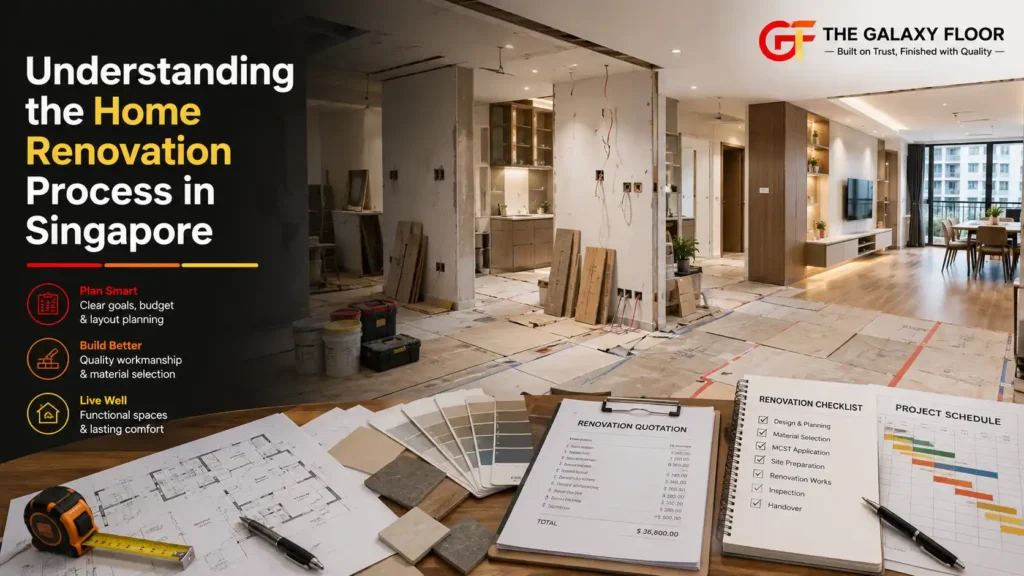
Renovation in Singapore is more structured than most homeowners expect. Many people start excited, then quickly feel lost. Permits, deposits, work schedules – it adds up fast. Missing one step can delay your entire project by weeks.
This is where experience matters. After more than 10 years working on HDB flats, condos, and landed homes across Singapore, we’ve seen the same problems repeat. Unclear timelines. Budget surprises. Contractors who disappear after the deposit. These are real issues with real solutions.
In this guide, you’ll learn the full renovation process from start to finish. We cover planning, permits, payment milestones, on-site work, and handover. You’ll also get practical tips to avoid common mistakes.
Planning and Approvals
Good renovation planning starts before you contact a single contractor. Most homeowners skip this stage. That’s the first mistake.
Start by deciding what you want. List every room. Note what stays and what changes. Think about your lifestyle needs. Do you cook daily? Do you work from home? These questions shape your design brief.
Planning also means setting a realistic timeline. Most HDB renovations take 6 to 10 weeks. Condo and landed projects can run longer. Build buffer time into your schedule. Don’t plan to move in the day renovation ends.
Pre-Renovation & Clearances
Before any work starts, several checks and approvals must happen. Skipping these creates problems later.
Defect Checking
Inspect your unit for existing defects before renovation begins. This protects you. If a crack or water stain exists before work starts, you need proof. Without it, the contractor may deny responsibility later.
Walk every room. Check walls, ceilings, floors, and pipes. Photograph everything. For new BTO flats, HDB provides a defect inspection period. Use it fully. Submit defect reports before your renovation starts.
Firm Selection
Choose your renovation firm carefully before signing anything. This decision affects everything. A wrong choice costs you time and money.
Check that the firm is a Casetrust-accredited or HDB-licensed contractor. These credentials matter in Singapore. They show the firm meets basic professional standards. Ask for their past project portfolio. Speak to previous customers if possible.
Get at least three quotes. Compare scope, materials, and timeline – not just price. The cheapest quote often leaves out important items. Read the contract line by line before you sign.
Permit Submissions
HDB and condo renovations require permit approval before work begins. This is not optional.
For HDB flats, your contractor must apply for a Renovation Permit through HDB. Only HDB-registered renovation contractors can submit this. The permit covers specific works like hacking walls, waterproofing, and installing grilles. Unapproved works can result in fines.
For condominiums, you need MCST approval. Each condo has its own rules. Some require detailed plans. Others have specific material restrictions. Submit early because approvals can take time.
Budget & Contingency
Set your full renovation budget before shortlisting contractors. Most people underestimate costs by 15% to 20%.
A clear budget helps you make faster decisions. It also prevents scope creep – the slow addition of extra items that push you over budget. Always keep a 10% to 15% contingency fund. Unexpected conditions inside walls, floors, or ceilings are common. You need cash to handle them without stopping work.
Financial Protection: Milestone Payments
Milestone payments protect both the homeowner and the contractor. This structure ties payments to completed work. Never pay the full amount upfront.
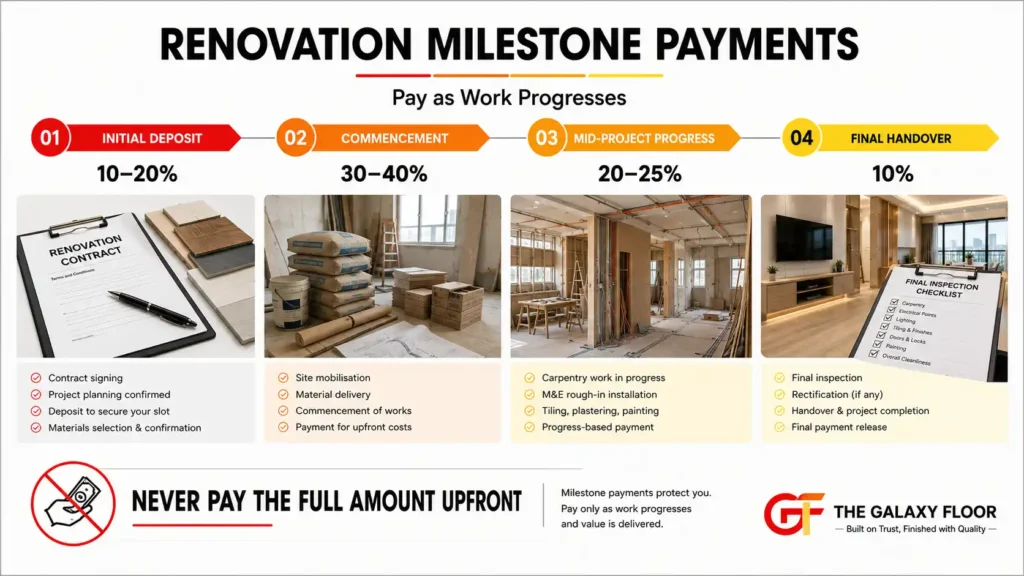
Initial Deposit (10% to 20%)
The initial deposit confirms your booking and starts the design process. This is typically 10% to 20% of the total contract value.
Pay this only after signing a proper contract. The contract should list every item, cost, material, and timeline. If a contractor asks for more than 20% upfront, that’s a red flag.
Commencement (30% to 40%)
The commencement payment is due when physical work begins on-site. This usually covers the cost of materials ordered and workers mobilised.
Check that work has actually started before releasing this payment. Visit the site. Confirm that demolition or hacking has begun. Never pay based on promises alone.
Mid-Project Progress (20% to 25%)
The progress payment is released when major works are substantially complete. This typically covers carpentry, masonry, and M&E (mechanical and electrical) rough-ins.
Inspect the work personally or with a project manager. Check that what you approved in the design matches what’s built. Flag issues immediately. It’s much easier to fix problems before finishes go in.
Final Handover (10%)
Hold back the final 10% until you are fully satisfied with the completed work. This is your last point of leverage.
Walk through every room. Test every switch, tap, socket, and fitting. Check all carpentry doors and drawers. Only release this payment after a proper handover inspection. Keep a snag list in writing.
On-Site Construction (Weeks 1–10)
Most renovations follow a fixed sequence. Structural work comes first. Finishes come last. Changing this order causes problems and rework.
| Week | Phase | Key Activities |
| 1–2 | Site Prep & Demolition | Hacking, debris removal, protection setup |
| 2–4 | Core Infrastructure & M&E | Electrical rewiring, plumbing rerouting, air-con points |
| 3–5 | Masonry & Wet Works | Tiling, waterproofing, bathroom and kitchen walls |
| 5–8 | Ceiling & Carpentry | False ceilings, built-in furniture, wardrobes, cabinets |
| 8–10 | Painting & Fixtures | Wall painting, light fittings, switches, final installations |
Weeks overlap in practice. A good contractor manages these phases without gaps. Long idle days on site usually signal poor scheduling.
Site Prep & Demolition
Demolition is the first physical phase of your renovation. Workers hack tiles, remove walls, and strip existing fixtures.
This phase produces the most dust and noise. Expect it. Proper contractors protect your neighbours’ common areas with boards and covers. They also remove debris quickly to keep the site safe.
Core Infrastructure & M&E
Electrical, plumbing, and air-conditioning work happens after demolition. This is called M&E – mechanical and electrical works.
All wiring, pipes, and cable trays go into walls and ceilings at this stage. This is the most critical phase. Mistakes here are expensive to fix later. Make sure your contractor uses proper-gauge wires and approved fittings.
Masonry & Wet Works
Tiling and waterproofing happen in the masonry phase. Bathrooms and kitchens need proper waterproofing before any tiles go down.
A failed waterproofing job causes serious leakage problems later. These problems affect your neighbours and damage your own unit. Always confirm that the contractor applies waterproofing correctly. Ask them to do a water ponding test before tiling starts.
Ceiling & Carpentry
False ceilings and built-in furniture are installed in this phase. Carpentry is often the most expensive part of any HDB renovation.
This is also where your home starts to look like the design. Check measurements carefully. Ensure all cabinet heights, depths, and finishes match your approved drawings. Once carpentry is fixed, changes are costly.
Painting & Fixtures
Painting happens near the end, after all dusty work is done. It’s the finishing layer. Quality matters here because it’s the first thing everyone sees.
Light fittings, switches, doorknobs, and bathroom accessories go in at this stage too. Do a final check on all surfaces before your handover inspection. Painting defects are easy to miss in bad lighting.
Site Management During Renovation
Good site management keeps your renovation on schedule and within budget. Poor management is the top cause of delays.
Site Access and Working Hours
Renovation work in Singapore has strict time restrictions. HDB allows renovation work only on weekdays and Saturdays, from 9am to 6pm. No work is allowed on Sundays or public holidays.
Condo rules vary. Check with your MCST for specific hours. Some condos restrict wet works to certain days. Confirm all this before your project starts to avoid disputes with neighbours.
Material Deliveries and Storage
Materials must be delivered and stored properly to avoid damage and complaints. Large deliveries should be planned for off-peak hours when possible.
Many condos require advance notice before deliveries. Confirm this with your building management. On-site, materials must not block common corridors or stairwells. Proper storage also prevents materials from warping or getting damaged before installation.
Progress Updates and Site Inspections
Visit your site regularly during renovation. Don’t rely only on photos or reports from your contractor.
Visit at least once a week. Bring your approved drawings. Check that work matches the plan. Raise any issues immediately and in writing. Good contractors welcome site visits. They use your feedback to keep the project on track.
Handover
Handover is the formal point where the contractor hands your completed home to you. This is not just collecting the keys.
A proper handover includes a full walkthrough with your contractor or project manager. Bring your contract and original drawings. Check every item in the scope of work. Test every fitting, switch, socket, and fixture. Note any issues on a defects list or snag list in writing.
Don’t feel rushed. Some contractors try to move quickly through handover. Take your time. The defects you miss now become harder to fix after you move in. Only sign the handover form after you are satisfied.
Defects Rectification After Handover
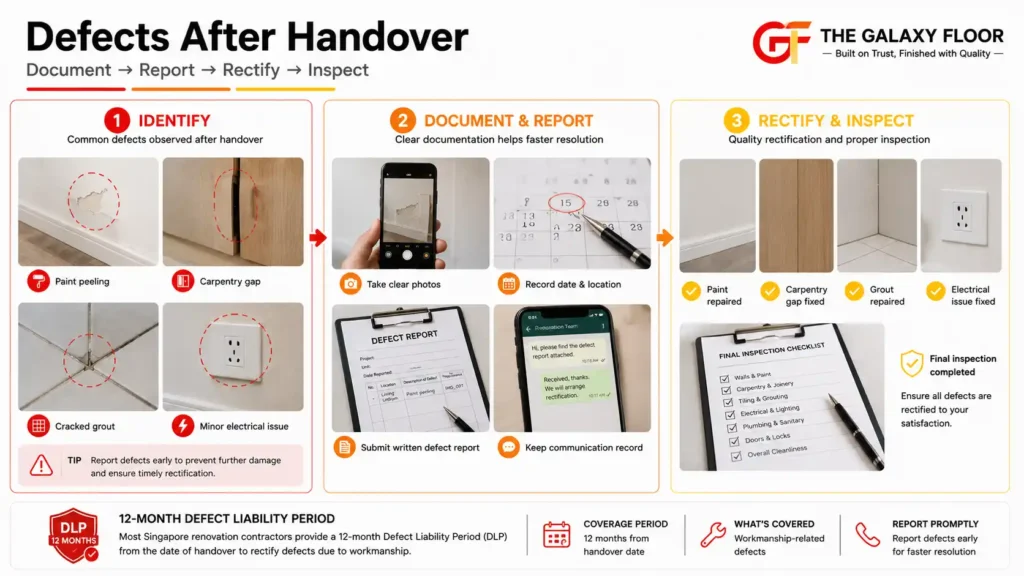
A defect warranty period typically follows handover. Most Singapore contractors provide a 12-month defect liability period (DLP). Check your contract for this clause.
Identifying and Documenting Defects
Document every defect as soon as you notice it. Don’t wait. Take clear photos. Note the date. Send the issue to your contractor in writing – email or messaging is fine.
Common defects include paint peeling, carpentry gaps, grout cracking, and minor electrical issues. Some appear only after you move in and start using the space. Report them promptly while you’re still within the warranty period.
Rectification and Follow-Up Inspection
Your contractor must fix reported defects within a reasonable time. What’s reasonable depends on the issue. A leaking pipe needs same-day attention. A paint touch-up can wait a week.
After rectification, inspect the fix carefully. Confirm the problem is fully resolved – not just patched over. If the contractor fails to respond within the warranty period, you have grounds to escalate. Keep all written records of reports and responses.
Frequently Asked Questions
What is the correct order to renovate a house?
The correct order is: demolition, structural work, M&E, masonry, carpentry, painting, and fixtures. This sequence prevents rework. Structural and infrastructure work always comes first. Finishes always come last. Changing this order creates costly mistakes.
What are the steps involved in renovating a home?
Home renovation involves planning, permits, contractor selection, construction, and handover. First, set your budget and design brief. Then get permits approved. Next, work begins in phases – demolition, M&E, tiling, carpentry, and painting. Finally, inspect the work thoroughly before accepting handover.
What are the renovation rules in Singapore?
Singapore renovation rules depend on your property type. HDB flats require an HDB Renovation Permit for specific works. Only HDB-registered contractors can apply for this permit. Condominiums need MCST approval and must follow house rules. All properties must respect work hour restrictions set by HDB and local regulations.
What are the biggest home renovation mistakes?
The biggest mistakes are paying too much upfront, skipping contracts, and ignoring permits. Other common errors include choosing contractors by price alone, not visiting the site regularly, and failing to set a contingency budget. Rushing the handover inspection is also a costly mistake many homeowners regret.
Do I need a permit to renovate my HDB?
Yes, most significant renovation works in HDB flats require an HDB Renovation Permit. This includes hacking walls, waterproofing bathrooms, installing grilles, and relocating plumbing. Your contractor submits this application. Only HDB-registered renovation contractors can do this. Minor works like painting do not need a permit.
How long does it take for HDB to approve a renovation permit?
HDB renovation permit approval typically takes about 3 to 5 working days. Approval time depends on the complexity of the work and whether all documents are complete. Your contractor should submit the application before work begins. Starting without approval risks fines and a stop-work order.
Can I start renovation before HDB completion?
No, you cannot renovate an HDB flat before collecting the keys and receiving official permission. You must first receive your keys from HDB. After that, your contractor applies for the renovation permit. Work can only begin after HDB approves the permit. Starting earlier is not allowed and can result in penalties.
What time is renovation allowed in Singapore?
HDB renovation is allowed on weekdays and Saturdays from 9am to 6pm only. No renovation is allowed on Sundays or public holidays. For condominiums, hours may differ depending on MCST rules. Some buildings restrict certain noisy works to specific days. Always confirm timing rules with your building management before work starts.
What is a realistic renovation budget?
A realistic renovation budget for an HDB flat in Singapore typically ranges from $30,000 to $80,000 or more. The actual cost depends on flat size, the extent of works, material choices, and carpentry volume. A 3-room flat with moderate works costs less than a 5-room flat with full custom carpentry. Always add a 10% to 15% contingency on top of your quoted amount.
What is the most expensive part of renovating a house?
Carpentry is usually the most expensive part of a Singapore home renovation. Built-in wardrobes, kitchen cabinets, and feature walls add up quickly. Bathroom and kitchen renovations also carry high costs due to waterproofing, tiling, and sanitary fittings. Electrical rewiring and air-conditioning installation are additional big-ticket items.
Conclusion
Understanding the renovation process helps you make smarter decisions at every stage. You now know the correct sequence – from permit approvals and pre-renovation checks to on-site construction and final handover. Each phase builds on the last. Skipping steps causes delays, disputes, and extra costs.
Financial protection matters as much as the work itself. Milestone payments keep your money safe. A proper contract protects your rights. Visiting your site regularly and documenting issues gives you real control over your project. These are not extras – they’re essentials.
Singapore Home Renovation Services brings over 10 years of hands-on experience to every project. We’ve worked on HDB flats, condominiums, and landed homes across Singapore. We handle permits, manage timelines, and keep you informed every step of the way.
Ready to start your renovation the right way? Contact us today for a free consultation. We’ll walk you through the full process and help you plan a project that stays on time and on budget.